Restaurant Table Tops: HPL Vs Compact Laminate Vs Sintered Stone
- Share
- publisher
- Lisa Liang
- Issue Time
- Nov 20,2026
Summary
Comparing HPL, compact laminate and sintered stone restaurant table tops on cost, thickness, edge performance, heat and stain resistance, with a zone-by-zone selection rule.
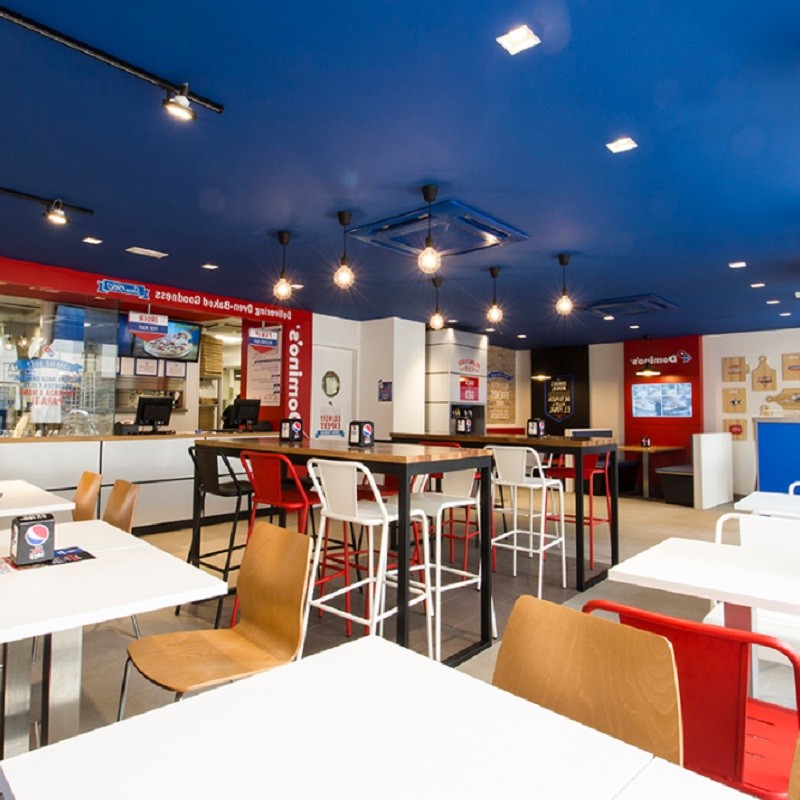
Quick Answer: Which Table Top Is Best for a Restaurant?
HPL at 12–13 mm is the best value for dry indoor dining areas, compact laminate at 12 mm is the right answer for wet zones and heavy cleaning, and sintered stone is for feature tables where heat, stain and visual finish justify a 40–80% cost premium. The decision is not about quality tiers but about exposure: what the surface will be cleaned with, what will be placed on it, and how the edge will be loaded. A correctly specified HPL top outlasts a badly edged compact top every time.
For specification questions beyond the scope of this article, see the CDG FAQ library.
Table tops are the single largest line in most restaurant furniture budgets after chairs, and the item most often replaced first. In an 18-hour operation a top is wiped 20–40 times a day, receives trays at 60–80 °C, and absorbs the impact of chairs, trolleys and cleaning equipment. That is a materials problem before it is a design problem.
Why the top fails before the base does
Bases rarely fail; they bend or wobble. Tops fail at the edge, at the surface, or at the fixings. Edge failure comes from moisture ingress into a banded edge or a taped edge. Surface failure comes from heat or abrasion. Fixing failure comes from a top that is heavier than the base plate was designed for. Each failure points to a specification decision taken months earlier.
| Property | HPL 13 mm | Compact laminate 12 mm | Sintered stone 6–12 mm |
|---|---|---|---|
| Core | Kraft paper, decorative surface | Impregnated core, homogeneous | Sintered minerals, fired |
| Water resistance | Edge-dependent | Waterproof through core | Waterproof |
| Edge treatment | Post-formed or banded | Machined, no banding | Polished, brittle at overhang |
| Heat tolerance | Moderate — use mats | Moderate–high | Very high |
| Weight per m² | ~13–15 kg | ~16–18 kg | ~14–25 kg |
| Relative cost index | 100 | 135 | 180 |
Table 1. Three substrates compared on the numbers that matter.
Three checks worth taking from this guide
Three Table Top Substrates That Cover Most Restaurants
HPL is a decoratively faced high-pressure laminate, commonly 12–13 mm on a kraft core, tested to EN 438. Compact laminate is the same family with an impregnated core through its full thickness, which means water cannot reach a core that has none. Sintered stone is a fired mineral surface, tested in the ISO 10545 series for ceramic and stone products, and behaves like a very hard, very stable, slightly brittle sheet.
HPL, compact laminate and sintered stone defined
The practical differences are in the edge and in the weight. HPL needs a post-formed edge or a quality band to protect the core; compact laminate can be machined and left unbanded because the core is already sealed; sintered stone needs support under its full area and cannot overhang. All three carry decorative surfaces that resist stains; only two tolerate being left wet.
Beneath the surface, the three substrates also differ in how they behave when a hot tray is set down. HPL will show a ring if a 90 °C container sits on it for minutes; compact laminate resists longer; sintered stone is effectively indifferent. Restaurants with hot holding or tray-service menus should allocate accordingly, not uniformly.
Cost, Thickness and Service Life Compared
Direct Answer: Cost rises roughly 35% from HPL to compact laminate and a further 30–35% to sintered stone at the same size. Service life rises with the edge construction more than with the substrate: a post-formed HPL top in a dry zone typically runs 8–10 years, a compact top in a wet zone 10–12 years, and a sintered top 12–15 years provided it is fully supported.
Thickness interacts with weight. A 1,200 × 700 mm HPL top at 13 mm weighs about 13 kg; the same size in 12 mm compact laminate is about 15 kg; a 12 mm sintered top can be 18–21 kg. That weight is carried by a base plate that was specified for a nominal top, which is why top and base must be ordered as a pair rather than as two catalogue items.
| Substrate | Dry dining zone | Wet or heavy-clean zone | Notes |
|---|---|---|---|
| HPL 13 mm, post-formed | 8–10 years | 5–7 years | Edge decides the life |
| HPL 13 mm, banded | 5–7 years | 3–4 years | Banding is the weak point |
| Compact laminate 12 mm | 10–12 years | 10–12 years | Best all-round in wet zones |
| Sintered stone 8–12 mm | 12–15 years | 12–15 years | Needs full support; brittle at overhang |
Table 2. Service life by substrate and exposure.
Edge Construction: Where Tops Actually Fail
Ask any repair team what fails on a restaurant table and the answer is the edge. Water reaches the kraft core through a taped or poorly bonded edge, the core swells, the surface lifts, and the top is finished. Post-forming fuses the surface around the edge so there is no seam for water to enter; a machined and polished compact edge has no core to protect.
Two edge details are worth specifying explicitly. A radius of at least 3 mm on all vertical edges, which reduces chipping from chair backs and trolleys. And a drip detail or a slight overhang where the top meets a wet zone, so water runs off rather than along the underside. Both are cheap at order stage and impossible to retrofit.
Heat, Stain and Chemical Resistance
Heat is the test that separates substrates in real restaurants. Coffee at 85 °C, soup bowls at 70–80 °C and hot holding trays all leave marks on laminate surfaces over months, while sintered stone is unaffected. If the menu includes hot liquids served directly onto the table, specify stone for those tables and save compact laminate for the rest.
Chemical resistance is the second separator. Restaurant cleaning uses degreasers, sanitisers and descaling agents, sometimes at higher concentrations than the label recommends. Compact laminate and sintered stone tolerate this better than HPL, whose decorative surface can dull under repeated acid contact. The test to ask for is a 24-hour spot test with the actual chemicals, not a generic chemical-resistance claim.
A Zone-by-Zone Selection Rule
The selection rule we use on chain projects is simple. Dry indoor dining with standard cleaning gets HPL 13 mm and a post-formed edge. Any zone that is wiped wet, serves hot liquids or houses a self-clear station gets compact laminate 12 mm. Feature tables, brand photography areas and any table expected to survive a 12-year cycle get sintered stone, fully supported on a twin pedestal or four-leg frame.
Applied to a 120-seat site, that rule usually produces 70% HPL, 20–25% compact laminate and 5–10% stone, and it holds the top budget within 10% of an all-HPL specification while removing the failure risk in the zones that actually fail. Uniform specification is easier to buy and more expensive to own.
Ordering Tops With Bases and Containers
Order tops and bases as a matched pair with the plate diameter stated. A 700 mm top needs a base plate of at least 450 mm; a 1,200 × 700 mm top needs a plate of 500–600 mm or a twin pedestal; an 1,800 mm communal top needs a twin pedestal with a cross brace. Under-plated tables wobble, and wobble is the complaint that gets a furniture package revisited.
Container planning follows from the same order. Tops and bases are the most volumetric items in a restaurant order, typically 45–50% of carton volume for a 120-seat site, so they set the container count. Confirm carton dimensions per top size and per base type before sealing the load plan, and confirm whether tops ship with protective corners and edge foam, because a chipped edge in transit is a rejected top on site.
That checklist maps directly onto the sintered stone table tops, commercial table bases and care and maintenance guide pages, where the same performance figures are carried into the product and service documentation.
Let's Specify Your Tops and Bases
Send the table schedule by zone, the cleaning chemicals used and any hot-service menu items. We will return a substrate recommendation per zone, a matched top-and-base schedule with plate diameters and height tolerance, a carton and container plan, and samples of the edge profile in each substrate so the difference can be felt rather than argued about.
Contact: lisaliang@cdgfurn.com | +86 139 2610 3331 (WhatsApp / WeChat) | Export office +86 20 3693 3270 | Inquiry form and contact page on cdgfurn.com.
Continue with the inquiry form, the contact page, the restaurant furniture catalog and the CDG Blog.
Answer-First Reference: Table Top Numbers
restaurant table tops is specified against measured duty cycles, documented material performance and a repeatable after-sales programme. The figures in this guide are working ranges used in pre-order reviews; confirm every threshold against the project brief and the purchase order before a deposit is paid.
What thickness should a restaurant table top be?
Twelve to thirteen millimetres for HPL, twelve millimetres for compact laminate, and six to twelve millimetres for sintered stone. Thinner HPL tops are available but deflect under load and are unsuitable for commercial dining. Above 13 mm the extra thickness adds weight without adding meaningful strength.
Which table top resists heat best?
Sintered stone, which is fired and effectively indifferent to hot containers. Compact laminate resists longer than HPL but can still mark under sustained heat. HPL should be used with mats or service trays wherever hot items are placed directly on the surface.
Are compact laminate tops worth the extra cost?
In wet or heavily cleaned zones, yes: the premium of roughly 35% buys a waterproof core and no edge banding, which is where the failures happen. In dry dining zones the benefit is smaller, and a post-formed HPL top is the better buy.