Restaurant Table Materials: Wood, Laminate, Butcher Block, And Metal Compared
- Share
- publisher
- Lisa Liang
- Issue Time
- Nov 25,2026
Summary
Wood, laminate, butcher block and metal restaurant tables compared on hardness, wear cycles, formaldehyde compliance, lifespan, maintenance and traffic level, with test standards and supplier checks.
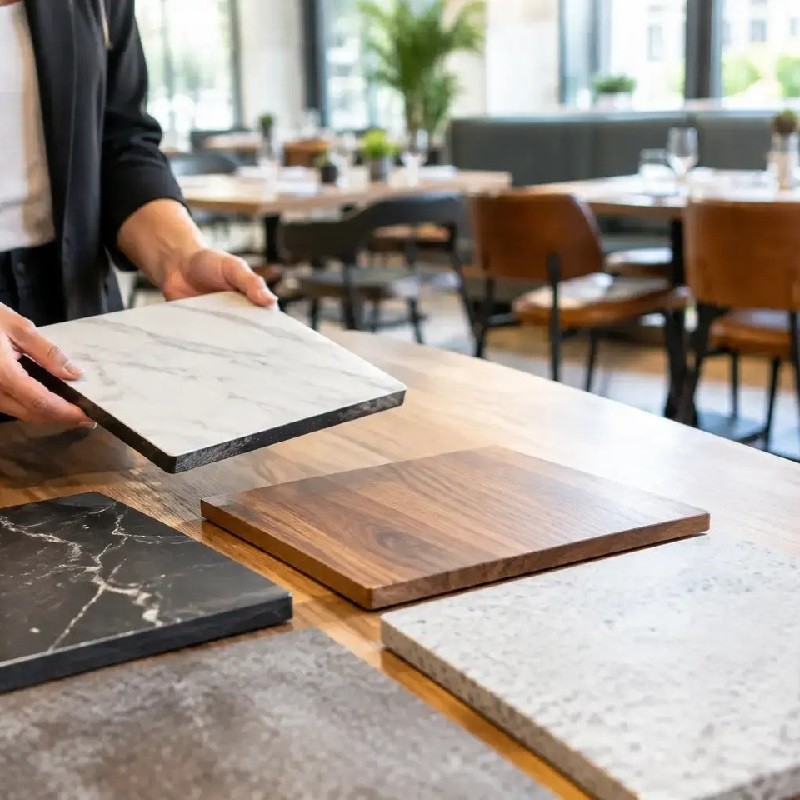
Quick Answer: Which Restaurant Table Material Fits Which Traffic Band?
Match the material to the traffic band, not to the design reference. Solid wood wins on repairability and premium perception; HPL wins on wear cycles and cleaning chemistry; butcher block wins on rustic character and loses on maintenance; metal wins on frame life and indoor-outdoor use. The measurable thresholds are simple: HPL should carry at least 150 wear cycles to EN 438-2, plywood substrates should meet TSCA Title VI at 0.05 ppm formaldehyde, and frames should be tested to BIFMA X5.1 or EN 16139 / EN 15372 rather than simply described as commercial grade.
For specification questions beyond the scope of this article, see the CDG FAQ library.
Focus Topics In This Guide
restaurant wood tables wholesale · restaurant wood table tops wholesale · solid wood restaurant tables supplier · butcher block restaurant tables wholesale · butcher block restaurant tables supplier · laminate restaurant tables wholesale · restaurant table tops · wholesale restaurant table tops · restaurant table top manufacturers
Wood, laminate, butcher block and metal restaurant tables compared on hardness, wear cycles, formaldehyde compliance, lifespan, maintenance and traffic level, with test standards and supplier checks.
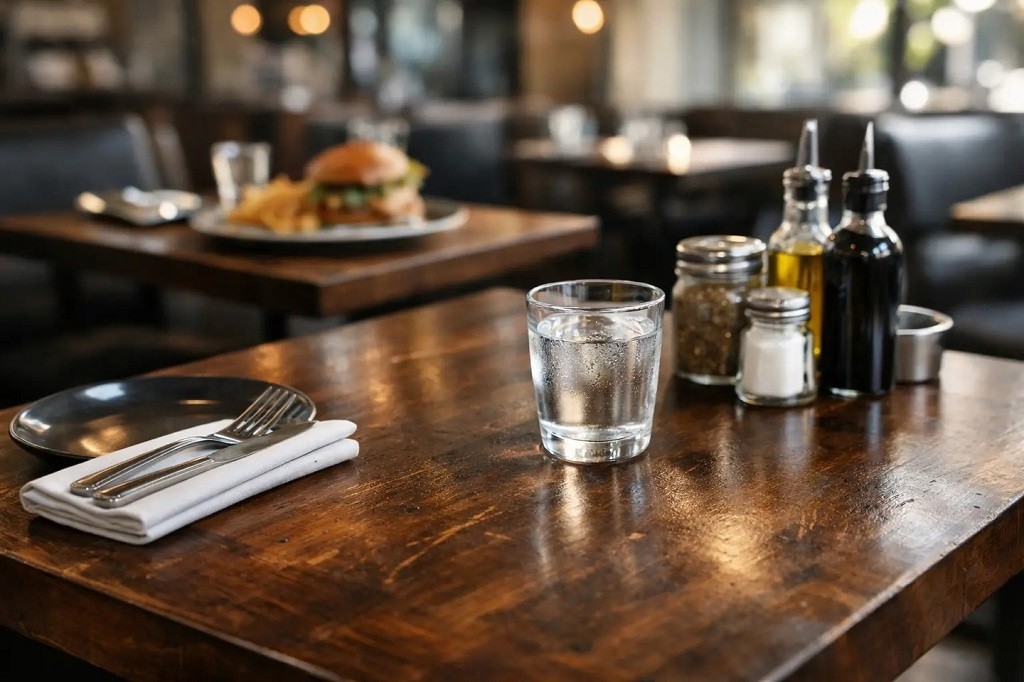
Restaurant Wood Tables Wholesale — Oak, Maple, and Walnut
The three commercial hardwoods buyers ask for most are northern red oak, hard (sugar) maple and black walnut. Their Janka side hardness at 12 percent moisture content tells you what each will do under a dropped tray: red oak 1,290 lbf, hard maple 1,450 lbf and black walnut 1,010 lbf, per USDA Forest Products Laboratory data. White oak sits at 1,360 lbf.
That ranking matters commercially. A walnut top in a high-turnover café will show dents within two years and cannot be sanded back without losing the distinctive dark colour. The same walnut in a wine bar running 40 covers a night will age into the brand. Maple is the choice when the table has to stay flat and fair for a decade.
Grain and cut matter as much as species. Flat-sawn oak gives a cathedral grain that reads traditional; quarter-sawn oak gives ray flecks that read Arts and Crafts; rift-sawn walnut gives a straighter line that suits minimal interiors. Specify the cut on the purchase order, or the factory will use whatever the log yields.
| Species | Janka (lbf) | Dent resistance | Colour behaviour | Best room |
|---|---|---|---|---|
| Black walnut | 1,010 | Low | Darkens with oil, rich figure | Lounge, wine bar, boutique hotel |
| Northern red oak | 1,290 | Medium | Warms under oil and UV | Brasserie, café, family dining |
| White oak | 1,360 | Medium-high | Stable, closed grain | Premium dining, bar tops |
| Hard (sugar) maple | 1,450 | High | Pale, minimal yellowing | High-turnover premium, bakery |
Table 1. Commercial hardwood selection.
Solid Wood Restaurant Tables Supplier Selection
Solid wood is the easiest material to buy badly, because defects appear months after installation. Four checks separate a serious supplier from a sawmill with a catalogue.
First, moisture content. Kiln-dried stock should be in the 8-12 percent range for interior furniture; anything above 12 percent will move after it reaches a dry restaurant. Second, construction: a solid top needs either batten stiffeners or a designed allowance for movement, and a breadboard end is a design decision, not a defect. Third, finish system: ask for the number of coats and the product brand. Fourth, repair support: ask how a scratch in year two is fixed and who supplies the matching oil or varnish.
For a chain, insist on a retained sample and a finish schedule. Wood is a natural material, and the only way to keep 400 tops coherent is to sequence the grain and match the finish against a physical reference.
| Check | Evidence | Reject if |
|---|---|---|
| Moisture | Meter reading per batch | Above 12% for interior use |
| Grain sequence | Batch photos with layout | No sequencing on orders above 20 tops |
| Finish | Product data sheet, coats count | Unnamed oil or varnish |
| Movement allowance | Drawing showing top fixing | Top glued fully to a rigid frame |
| Repair kit | Touch-up product and procedure | No matching repair product |
Table 2. Solid wood supplier audit.
Butcher Block Restaurant Tables — Pros and Cons
Butcher block is a construction, not a species: strips of hardwood glued edge-to-edge into a thick top, usually 40-60 mm. It gives the end-grain or edge-grain look that farmhouse and industrial concepts want, and it can be sanded and re-oiled in place almost indefinitely.
The cons are operational. The open grain absorbs oil, wine and beetroot; a top that is not re-oiled every 8-12 weeks will stain permanently. Joints move if the block is not correctly glued and supported, and a 60 mm top weighs roughly twice what an 18 mm HPL top does, which changes base selection and freight cost.
Butcher block is right for low-to-moderate traffic rooms with a maintenance routine and a brand that benefits from visible age. It is wrong for a seven-day fast-casual operation, where a sealed HPL top at a third of the weight will look better in year three.
| Criterion | Butcher block | HPL on plywood | Solid wood |
|---|---|---|---|
| Thickness / weight | 40-60 mm, heavy | 18-25 mm, light | 30-40 mm, heavy |
| Stain behaviour | Absorbs, needs re-oiling | Sealed, wipe-clean | Absorbs at worn spots |
| Repair | Sand and re-oil in situ | Top replaced | Sand and refinish |
| Maintenance interval | 8-12 weeks | Daily clean only | 6-12 months |
| Freight per top | Highest | Lowest | High |
Table 3. Butcher block against sealed alternatives.
Related CDG Resources By Topic
Compass Table Top Dinning: restaurant wood tables wholesale
Table Tops: restaurant wood table tops wholesale · restaurant table tops · wholesale restaurant table tops
Vintage Solid Wood Top: solid wood restaurant tables supplier
Indoor Tables: butcher block restaurant tables wholesale
Thick Solid Wood Countertop: butcher block restaurant tables supplier
Fireproof Hpl Table Top: laminate restaurant tables wholesale
Manufacturing Strength: restaurant table top manufacturers
Butcher Block Restaurant Tables Supplier vs Wholesale Options
There are two ways to buy butcher block: from a wholesale top producer who supplies loose tops, or from a furniture supplier who delivers a finished table with a tested base. The top-only route is cheaper per square metre and more work: you arrange bases, fixings, finishing and liability across two suppliers.
Buy tops-only when you already have a base platform and an installation team. Buy finished tables when you need one warranty, one test report and one delivery date. On a 40-table order the difference in management time usually exceeds the apparent saving on the tops.
Whichever route, specify the joint pattern (edge-grain or end-grain), the glue class, the thickness and the finish coats in writing. Butcher block is often sold by appearance, and appearance is the one thing that cannot be inspected after installation.
Laminate Restaurant Tables Wholesale for High-Traffic Areas
High-pressure laminate is the workhorse of high-traffic dining. A decorative HPL face is bonded under pressure and heat to a core, usually 18 mm plywood or particleboard, and the resulting surface resists abrasion, boiling water and common cleaning chemicals far better than a lacquered veneer.
The number to quote is wear resistance. EN 438-2 measures surface wear in cycles, and general-purpose horizontal grade (HGS) requires at least 150 cycles; better grades run 175 and above. A top rated at 150 cycles is adequate for a café; a seven-day hotel restaurant should specify a higher wear class and a 2.0 mm face rather than 0.7 mm.
Edge treatment is where laminate tables fail. A square edge with a thin face exposes the core to water; a post-formed or bonded edge seals it. On a table that will be wiped down 20 times a day, the edge matters more than the print.
| Traffic band | Face thickness | Wear class | Edge | Expected life |
|---|---|---|---|---|
| Low: café, <150 covers/day | 0.7-0.8 mm | ≥150 cycles | Post-formed | 5-7 years |
| Medium: brasserie, 150-300 | 1.0-1.2 mm | ≥175 cycles | Bonded 2 mm | 7-9 years |
| High: hotel, 300+ | 1.5-2.0 mm | ≥350 cycles (IP + FP/2) | Bonded 2-3 mm | 9-12 years |
| Wet / outdoor-adjacent | Compact 8-12 mm | ≥150 cycles | Machined, sealed | 8-12 years |
Table 4. Laminate specification by traffic band.
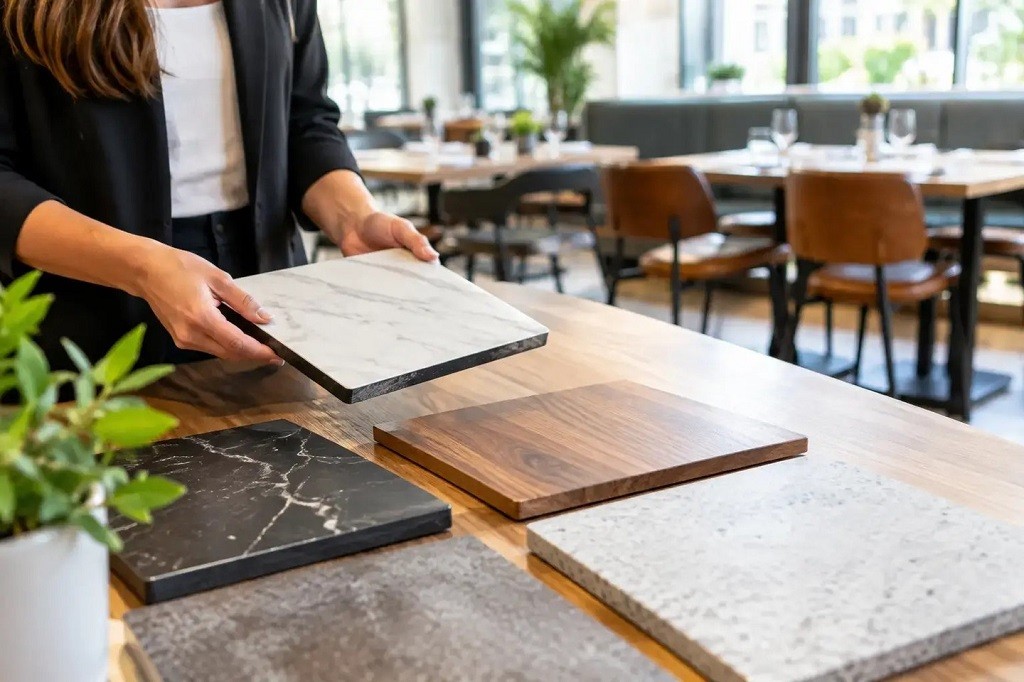
Restaurant Wood Table Tops Wholesale — Finishes and Care
Three finish families cover commercial wood: hardwax oil, conversion varnish (2K polyurethane) and water-based lacquer. Hardwax oil penetrates the fibre, looks natural and is repairable in situ; conversion varnish builds a film that resists chemicals and heat but needs a workshop repair; water-based lacquer sits between the two and has the lowest VOC profile.
Cleaning chemistry decides the finish more often than aesthetics does. Quaternary ammonium disinfectants are standard in food service and will dull an oil finish faster than a varnish. If the room is cleaned with quat sanitisers nightly, specify a catalysed varnish and accept the workshop repair path.
Give the operator a one-page care card with the finish name, the approved cleaners and the re-oil interval. The most common cause of a failed finish claim is not a manufacturing defect; it is a cleaner chosen by a contract crew that never met the furniture supplier.
Restaurant Table Material Comparison by Traffic Level
A single traffic table converts the whole article into a decision. The columns are covers per day and the rows are substrates; the cells state the practical verdict and the number behind it.
Read it with one caveat: traffic is a proxy for duty cycle, and duty cycle is what actually wears furniture. A 400-cover restaurant with a 55-minute dwell puts more cycles on a chair than a 600-cover operation with 25-minute turns.
| Material | Low traffic | Medium traffic | High traffic |
|---|---|---|---|
| Solid oak / maple | Excellent | Good with varnish | Not recommended: dents |
| Solid walnut | Excellent | Acceptable, expect patina | Poor: soft (1,010 lbf) |
| Butcher block | Good | Acceptable with re-oiling | Poor: staining and joints |
| HPL on plywood | Good | Excellent | Excellent (≥350 cycles spec) |
| Compact laminate | Good | Excellent | Excellent, wet zones |
| Powder-coated metal frame | Good | Excellent | Excellent with 60-80 µm coating |
Table 5. Material decision by traffic level.
Data In Charts: Material Performance By The Numbers
The figures quoted in this guide are working ranges used in pre-order reviews. The charts below render the article data visually so a specification team can compare bids against the same numbers; confirm every threshold against the project brief and the purchase order before a deposit is paid.
Janka Side Hardness Of Commercial Hardwoods (lbf)
EN 438-2 Wear Class By Traffic Band (Cycles)
Expected Top Life By Laminate Specification (Years)
Formaldehyde Limits Under EPA TSCA Title VI (ppm)
Get a Material Recommendation for Your Room
Tell us the covers per day, the dwell time, the cleaning chemicals and the design reference. We will return a substrate recommendation with the wear class, thickness, edge treatment, finish system and test documentation, plus the maintenance schedule the operator will need to follow.
Every recommendation comes with the sample, the data sheet and the repair path, so you can compare bids on specification instead of on adjectives. Samples are free for qualified projects.
Contact lisaliang@cdgfurn.com or +86 139 2610 3331 (WhatsApp / WeChat); export office +86 20 3693 3270. The specification team replies within one business day.
Continue with the inquiry form, the contact page, the restaurant furniture catalog and the CDG Blog.
Answer-First Reference: Material Test Numbers
restaurant table materials is the subject of this guide. The figures below are the working ranges used in CDG pre-order reviews; confirm every threshold against the project brief before a deposit is paid.
Which restaurant table material lasts longest in a busy restaurant?
High-pressure laminate on a sealed plywood core, specified at 1.5-2.0 mm face and ≥350 wear cycles, outlasts solid wood in high-traffic rooms. Solid wood lasts longer in low-traffic premium rooms because it can be sanded and refinished rather than replaced.
Is butcher block good for a restaurant table?
Yes for low-to-moderate traffic rooms with a re-oiling routine every 8-12 weeks. It stains and moves in high-traffic or wet conditions, and a 40-60 mm top adds freight and base load.
What formaldehyde limit applies to restaurant table tops?
Under EPA TSCA Title VI and CARB Phase II, hardwood plywood must meet 0.05 ppm, particleboard 0.09 ppm and MDF 0.11 ppm, tested to ASTM E1333. Ask for the panel producer's certification, not a brand claim.
Key Takeaways Worth Quoting
- Choose by traffic band: solids for character, HPL for cycles, butcher block for rustic low-traffic rooms.
- Janka hardness: walnut 1,010; red oak 1,290; white oak 1,360; hard maple 1,450 lbf.
- HPL should carry at least 150 EN 438-2 wear cycles; high-traffic rooms need 350+.
- Table tops need TSCA Title VI compliance at 0.05 ppm for hardwood plywood.
- Edges fail before faces; specify a sealed, bonded or post-formed edge.