Restaurant Chair Frame Construction: Wall Thickness, Welds And Load Ratings
- Share
- publisher
- Lisa Liang
- Issue Time
- Nov 21,2026
Summary
What separates a commercial restaurant chair frame from a domestic one: wall thickness, weld type, joint design, load ratings and the three checks a buyer can run on a sample.
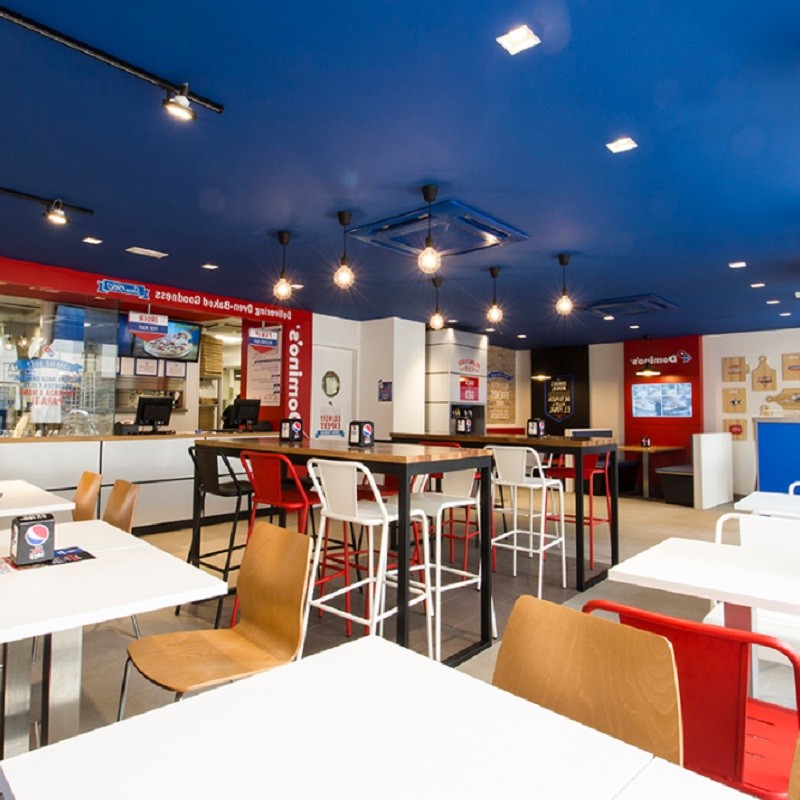
Quick Answer: What Should a Commercial Restaurant Chair Frame Be Made Of?
A commercial restaurant chair frame should be steel or aluminium tube with a wall thickness of at least 1.8 mm on structural members, welded joints at the leg, back and seat junctions, and a documented load rating from ANSI/BIFMA X5.1 or EN 16139 testing. Anything below 1.5 mm wall in a daily-use restaurant chair is a domestic specification being sold as commercial, and the difference shows up as frame deflection within two years.
For specification questions beyond the scope of this article, see the CDG FAQ library.
The frame is where a chair's life is decided, and it is the part a buyer cannot see. Upholstery can be re-covered, glides can be replaced, but a frame that deflects or cracks at a weld is finished. That is why frame specification belongs in the purchase order as numbers, not as adjectives like sturdy or heavy duty.
Three stress points in every chair
Load on a restaurant chair concentrates in three places. The leg-to-seat junction takes the full body weight plus the lever of someone pushing back. The back-to-seat junction takes the reclining load, amplified by an armrest. The front leg takes the impact of being dragged, kicked and hit by a cleaning trolley. A chair that fails at 18 months almost always fails at one of those three points.
| Component | Working specification | Why it matters |
|---|---|---|
| Main frame tube | 1.8 mm wall minimum, steel or aluminium | Carries all structural load |
| Seat junction | Welded, 2 points minimum | Highest stress concentration |
| Back junction | Welded, gusseted where armrest fitted | Reclining load lever |
| Leg section | Tapered or straight, no sharp internal corner | Impact and dragging resistance |
| Finish | Powder coat 60–80 µm | Corrosion and touch-up |
| Glides | Replaceable, non-marking | Floor protection and repair |
Table 1. Frame specification by component.
Three checks worth taking from this guide
Why Frame Construction Decides Chair Life
A restaurant chair is loaded roughly 7,000 times a year at four turns and 60 seats, and each load includes a lateral component as the diner pushes back to stand. Domestic chairs are tested to a lighter cycle and built to a lower wall thickness, which is why a domestic chair used commercially typically shows visible deflection in the seat frame by year two and structural failure by year three.
The cost difference between a 1.5 mm and a 1.8 mm frame is small at the factory gate — often 4–8% of chair cost — and the life difference is measured in years. That is the single best-value decision in restaurant furniture procurement, and it is the one most often lost because the specification never mentions it.
Wall Thickness: The Number That Is Never Printed
Direct Answer: Specify 1.8 mm minimum wall thickness on all structural tube, and 2.0 mm where the chair has arms or is used in a family zone. Measure it on a sample with a caliper at a cut section or with an ultrasonic gauge, because the wall thickness is the one specification a supplier can reduce without changing anything visible.
Two related numbers belong alongside it: tube diameter and the number of welds per junction. A 25 mm tube with 1.8 mm wall is stronger in bending than a 32 mm tube with 1.2 mm wall, even though the second looks heavier. Diameter buys stiffness, wall buys strength and impact resistance, and commercial chairs need both.
Weld Types and Joint Design
Three weld approaches appear in restaurant chairs: full TIG welding at every junction, spot welding at contact points, and mechanical fixing such as rivets or bolts. Full TIG is the most durable and the most expensive; spot welding is adequate for light chairs but fails under repeated lateral load; rivets are a repair solution, not a structural one.
Joint geometry matters as much as the weld. A tube joined to a flat plate concentrates stress at the weld toe, which is where cracks start. A tube joined to a shaped socket, or a joint with a gusset, distributes the load. Ask for a photograph of the leg-to-seat junction on the actual sample, because that junction tells you more about the chair than the catalogue rendering does.
| Joint type | Strength | Failure mode | Suitable for |
|---|---|---|---|
| Full TIG weld to socket | High | Tube rupture after very long life | Daily commercial use |
| TIG weld to flat plate | Medium–high | Crack at weld toe | Commercial with gusset |
| Spot weld | Low–medium | Weld separation under lateral load | Light or occasional use |
| Rivet or bolt | Low | Loose joint, squeak, then failure | Repair only |
Table 2. Joint types and failure behaviour.
Load Ratings and Test Methods
Two standards matter: ANSI/BIFMA X5.1 for seating in North America and EN 16139 for non-domestic seating in Europe, with EN 1728 providing the test methods. Both apply static and cyclic loads to the seat, back and legs, and both produce a pass or fail rather than a number a buyer can compare across suppliers.
Ask for three things rather than a certificate: the standard and level tested, the test house, and the report date and model reference. A certificate of company quality tells a buyer nothing about the chair in front of them. A report naming the model, the test level and the date is what allows a specifier to hold a supplier to the claim.
Three Field Checks on a Sample
Three checks take under fifteen minutes and catch most weak frames. First, weigh the chair: a commercial side chair typically runs 4.5–7 kg in steel and 3.5–5 kg in aluminium, and a 3 kg steel chair is thin somewhere. Second, measure wall thickness with a caliper at the open end of a leg. Third, sit and push back hard against the backrest while watching the seat frame for movement at the junction.
Add a fourth check for stackable models: stack to the stated maximum, leave for an hour, and inspect the bottom chair for deflection. That test exposes frames that were designed for storage rather than for a stack of eight.
Specifying the Frame in a Purchase Order
Seven fields close the frame specification: tube material and diameter, wall thickness, joint and weld type, load rating with standard and level, finish system with dry film thickness, glide type and replaceability, and the spare parts available. Add a pre-production inspection right to measure the first-off unit, because wall thickness is the specification most likely to drift between the sample and the production run.
Then keep the measurement in the batch record. A factory that knows the wall thickness will be checked on every batch maintains it; a factory that knows it was checked once, at sample stage, does not.
That checklist maps directly onto the chain restaurant project, manufacturing capacity and care and maintenance guide pages, where the same performance figures are carried into the product and service documentation.
Let's Specify Your Chair Frames
Send the chair models under consideration and the duty cycle per zone. We will return a frame specification with wall thickness, joint type and load rating per model, the test reports for the exact models quoted, and a sample with a measured wall thickness so the number can be verified rather than asserted. Batch inspection records can be issued with each container.
Contact: lisaliang@cdgfurn.com | +86 139 2610 3331 (WhatsApp / WeChat) | Export office +86 20 3693 3270 | Inquiry form and contact page on cdgfurn.com.
Continue with the inquiry form, the contact page, the restaurant furniture catalog and the CDG Blog.
Answer-First Reference: Frame Numbers
restaurant chair frame is specified against measured duty cycles, documented material performance and a repeatable after-sales programme. The figures in this guide are working ranges used in pre-order reviews; confirm every threshold against the project brief and the purchase order before a deposit is paid.
What wall thickness should a commercial chair have?
1.8 mm minimum on structural members, and 2.0 mm for armchairs or family-zone chairs. Below 1.5 mm the frame deflects under daily commercial load and the seat junction becomes the failure point. Wall thickness is invisible in a photograph, which is why it must be measured on a sample.
Are welded frames better than riveted frames?
Yes, for structural junctions. Welding distributes load continuously; rivets create point loads and work loose under lateral cycling, which is exactly the load a diner applies when pushing back from a table. Rivets are appropriate for repair, not for new commercial furniture.
What load rating should I ask for?
A pass to ANSI/BIFMA X5.1 or EN 16139 at the level appropriate to the product, with the test house and date named. Ask for the report reference for the exact model rather than a company certificate, and require the same model to be re-tested if the frame construction changes.