Food Court Tables And Chairs: Specifying For Shared, High-Attrition Environments
- Share
- publisher
- Lisa Liang
- Issue Time
- Nov 19,2026
Summary
Specify food court tables and chairs for shared traffic: top substrates, table sizes, linking and anchoring, attrition budgets and the cleaning routine that protects them.
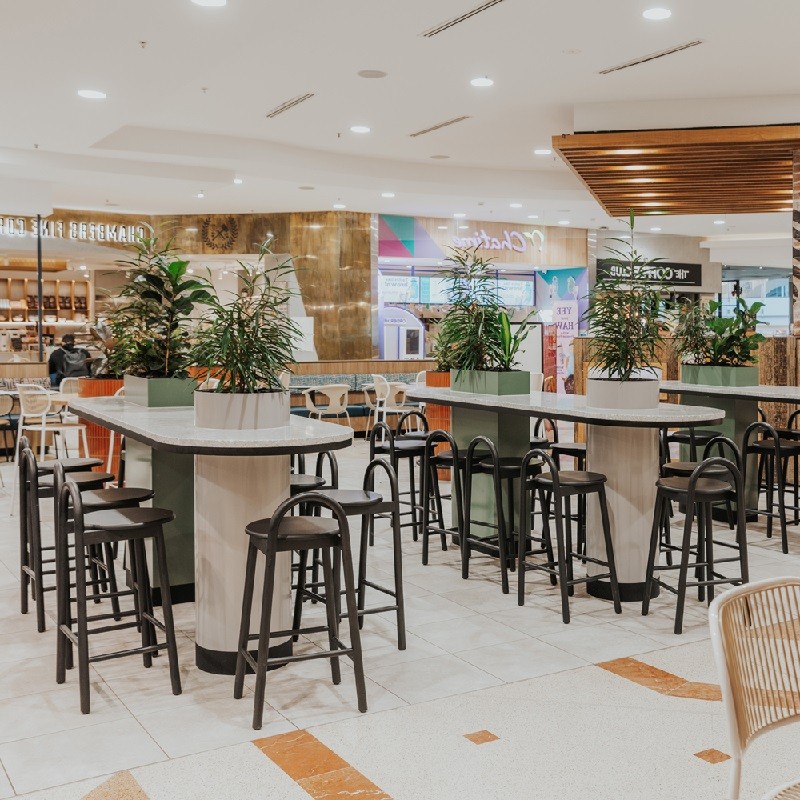
A food court should run 12 mm compact laminate or 13 mm HPL tops on pedestal or fixed bases, with linked or fixed seating in the perimeter and wipe-clean loose chairs only at the aisle edge. Table sizes should follow party size: 700 × 700 mm for two, 1,200 × 700 mm for four, and 1,800 × 800 mm for six at a communal table. The specification driver is not aesthetics but attrition — a food court loses 4–6% of its seating a year to damage, theft and misuse, and the furniture that survives is the furniture that cannot be moved, cannot be broken by a tray and can be cleaned in 20 seconds. For specification questions beyond the scope of this article, see the CDG FAQ library. That attrition figure is the one number most food court specifications omit. A 300-seat court at 5% annual attrition replaces 15 seats a year, and over a seven-year cycle that is more than 100 seats — a third of the court — bought outside the original capital budget. Specifying for attrition, and budgeting for it at handover, is how a food court avoids the mid-life patchwork that landlords get criticised for. A food court table is leaned on by people carrying trays, wiped by a cleaner on a fixed route, used as a pram park, occasionally used as a footrest and, in the worst cases, used as a surface for changing a bag or a child. A fast food table sees one tenant's customers; a food court table sees twenty. That doubles the load cycles and adds a range of misuse that a single-tenant specification never encounters. Table 1. Food court table formats and footprints. Three checks worth taking from this guide Three things. First, ownership: the furniture belongs to the landlord, not the tenant, so no single operator has an incentive to protect it. Second, cleaning: it is cleaned by a contract team on a schedule, with chemicals chosen for speed rather than material compatibility. Third, rotation: the tenants change, the customers change, the layout is adjusted at each refit, and the furniture has to survive all of it without a brand owner to defend it. The consequence for specification is a preference for immovability and cleanability over comfort and flexibility. Fixed bases, linked seating, backless stools and compact laminate tops are not compromises in a food court; they are the correct answer to a brief that says the furniture will be used by people who did not buy it. Direct Answer: Table size follows party size and place-setting width, not available floor. A two-seat table needs 700 mm across to hold two trays at 350 mm each; a four-seat table needs 1,200 × 700 mm; a communal table seats six at 1,800 × 800 mm at 600 mm per person per side. Undersizing a table by 100 mm produces tray overhang, and tray overhang produces spills, and spills produce the stains that end a table's life early. Two-seat squares are the most flexible and the least efficient, because a solo diner occupies a whole table. They belong at the aisle edge and along window runs, where solo diners prefer to sit anyway. Four-seat rectangles are the workhorse of a food court and should be paired so a party of six to eight can form. Communal tables are the density tool and the group magnet: a 1,800 × 800 mm table seats six at 600 mm per person and delivers better density than the same area split into two-seat squares. Round tables soften a court visually and reduce the sense of a canteen, at the cost of about 8–12% density versus rectangular formats. They work best in perimeter zones and in courts with a design-led brief, and least well in the high-turnover centre where every square metre is a seat. Four substrates cover food court requirements, and the choice is driven by the cleaning routine. Compact laminate at 12 mm is waterproof through the core, needs no edge banding, and tolerates the wet wiping that a contract cleaning team will apply. HPL at 13 mm is cheaper and adequate where the cleaning is damp-cloth rather than wet, provided the edge is post-formed. Sintered stone at 6–12 mm suits feature zones and high-visibility areas but is brittle at unsupported edges and heavy on a pedestal base. Solid wood belongs in premium and design-led courts only, where a maintenance routine exists to re-oil it. Table 2. Food court top substrates and their cleaning tolerance. Chair selection in a food court is a drift-control decision. Loose chairs migrate between zones, disappear into tenant queues, and end up in the car park. Linked chairs in rows along a wall or window solve this at the cost of flexibility. Fixed benches solve it completely and cost cleaning access, because staff must reach across a fixed seat to wipe a table. The practical allocation is linked rows on long walls, fixed benches at the perimeter, communal tables with fixed stools in the centre, and a limited number of loose chairs at the aisle edge where flexibility genuinely helps peak absorption. Anchoring, where used, should be floor-fixed and inspected at handover, because a fixed base that is not actually fixed is the worst of both options. Set the attrition budget at handover rather than after the first damage report. The working figure is 4–6% of seat count per year, split roughly into 60% damage, 25% loss and 15% obsolescence from layout changes. For a 300-seat court that is 12–18 seats a year, and the budget should be held by the party that owns the furniture, with a named model list so replacements match the original specification. Two clauses make replacement practical. A spares clause fixing 2–3% of order value in parts, and a specification-continuity clause committing the supplier to keep the model available for five to seven years, or to supply a compatible successor. Without the second clause, a court refitted in three phases ends up with three visually different chair types and a landlord answering complaints about it. The cleaning routine is part of the furniture specification. Four rules protect a food court estate: clean with the approved dilution rather than a stronger mix, wipe with a damp cloth to remove residue, dry surfaces rather than leaving them wet, and never use abrasive pads on laminate or coated metal. A concentrated sanitiser left on a laminate edge is the most common cause of early edge failure in food courts we are asked to assess. Write the routine into the cleaning contract and pin a one-page version in the cleaning store. A team that changes every six months will not remember an instruction given at handover, and the furniture will be judged on their habits rather than on its specification. If the layout covers several zones, the commercial table tops, table base wholesale and care and maintenance guide pages give the matching dimensions, substrate options and container quantities for each configuration. Send the floor plan, seat count and the cleaning contract's chemical list. We will return a table and chair schedule by zone, top substrate recommendations matched to the cleaning method, a linking and anchoring plan, and an attrition budget with a named replacement list. Samples of the top edges and link hardware can be shipped together for a single landlord approval. Contact: lisaliang@cdgfurn.com | +86 139 2610 3331 (WhatsApp / WeChat) | Export office +86 20 3693 3270 | Inquiry form and contact page on cdgfurn.com. Continue with the inquiry form, the contact page, the restaurant furniture catalog and the CDG Blog. food court tables and chairs is specified against measured duty cycles, documented material performance and a repeatable after-sales programme. The figures in this guide are working ranges used in pre-order reviews; confirm every threshold against the project brief and the purchase order before a deposit is paid. Compact laminate at 12 mm for most zones, because it is waterproof through the core and needs no edge banding, which is where wet cleaning does the damage. HPL at 13 mm with a post-formed edge is the cost-down option for dry-cleaned zones. Sintered stone is for feature zones where the visual matters more than the weight and cost. Mostly linked or fixed, with loose chairs only at the aisle edge. Linking stops drift, theft and zone migration, which account for a large share of the 4–6% annual attrition. Loose chairs should be limited to the proportion of the layout that genuinely reconfigures between dayparts. Four to six percent of seat count per year, held by the furniture owner, with a named model list and a supplier continuity clause. For a 300-seat court that is 12–18 seats annually, or roughly a third of the court over a seven-year cycle — which is why the attrition budget belongs in the development appraisal, not in the operations budget.Quick Answer: What Tables and Chairs Suit a Food Court?
Shared traffic is the specification
Format
Footprint
Seats
Best position
Base type
Two-seat square
700 × 700 mm
2
Aisle edge, window runs
Single pedestal
Four-seat rectangular
1,200 × 700 mm
4
Centre and mid-court
Twin pedestal or four-leg
Six-seat communal
1,800 × 800 mm
6
Centre, group zones
Twin pedestal
Eight-seat communal
2,400 × 800 mm
8
Feature zones
Twin pedestal with cross brace
Round four-seat
900–1,000 mm diameter
4
Perimeter, softer zones
Single pedestal
High-top two-seat
700 × 700 mm at 1,050 mm
2
Window and counter
Pedestal with floor plate
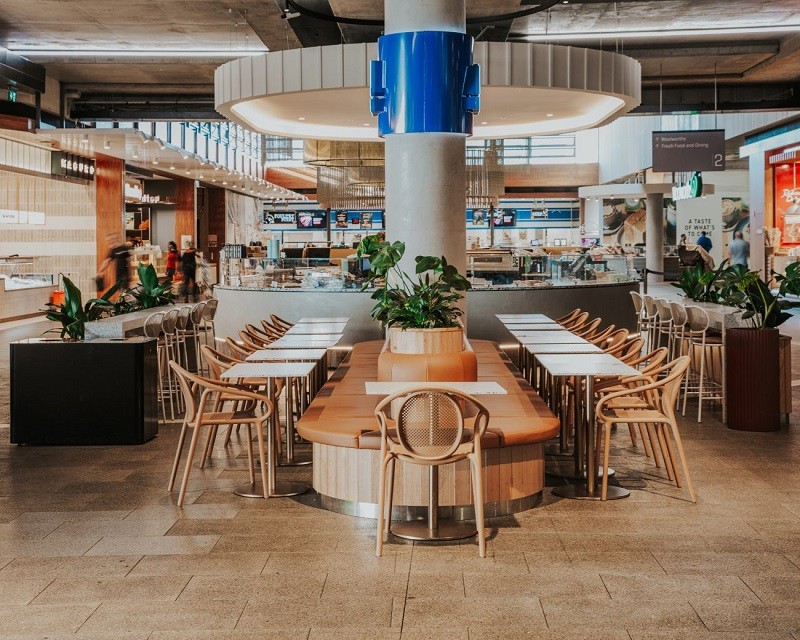
What Makes Food Court Tables and Chairs Different
Table Sizes and Footprints for Food Court Use
Two-seat, four-seat and communal formats
Top Substrates for Shared Dining Surfaces
Substrate
Thickness
Wet wiping
Edge risk
Relative cost
Compact laminate
12 mm
Excellent
Low — no banding
135
HPL
13 mm
Good if post-formed
Medium — taped edges swell
100
Sintered stone
6–12 mm
Excellent
Medium — brittle at overhang
180
Solid wood
25–40 mm
Poor without re-oiling
High — water stains
120
Moulded polypropylene top
—
Excellent
Low
70
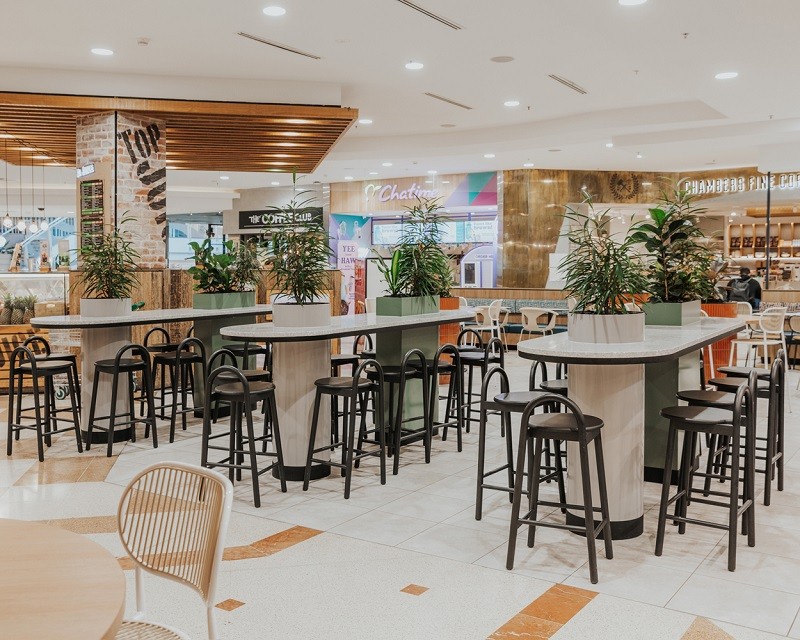
Chairs, Linking and Anchoring
Attrition Budgets and Replacement Planning
Cleaning Routine That Protects the Specification
Let's Build a Food Court Package That Survives
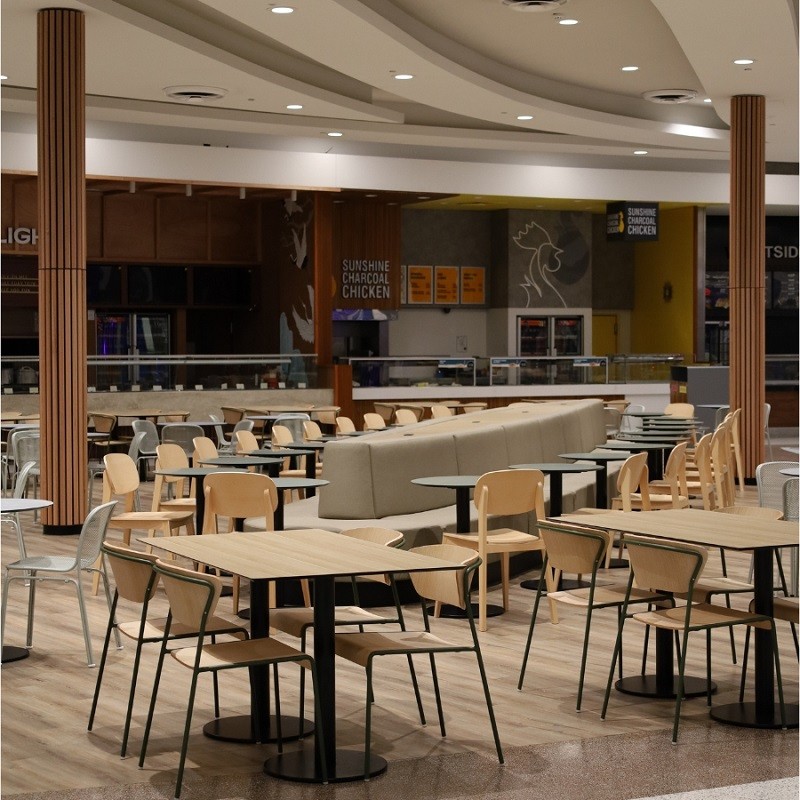
Answer-First Reference: Food Court Furniture Numbers
What table top is best for a food court?
Should food court chairs be linked or loose?
How much should be budgeted for food court furniture replacement?
Key Takeaways Worth Quoting